
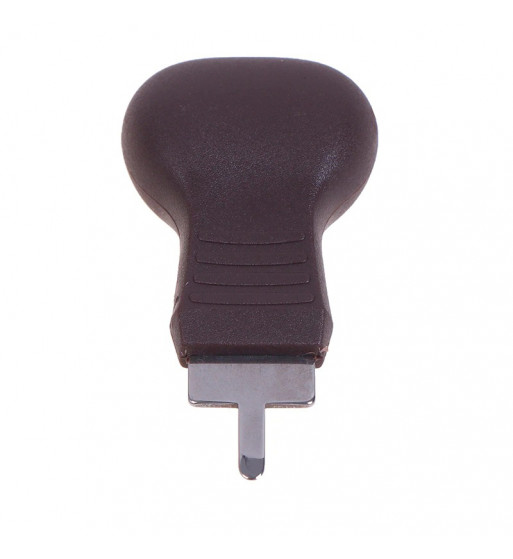
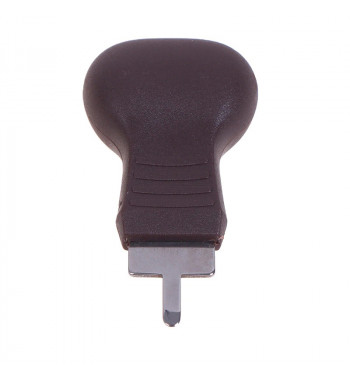
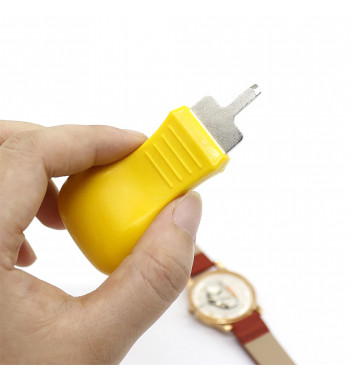
Fine-tip watch opening tool. Designed for watchmakers and home repair of mechanical, automatic and quartz watches.
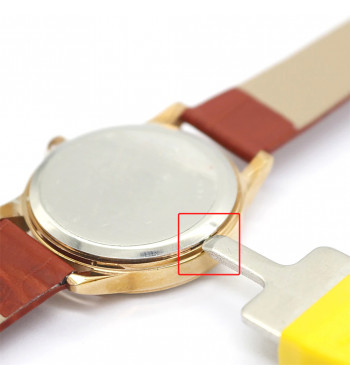
When the case-back slot is barely visible, only a fine-tip opener can lift the cover without marking the bezel. This precision tool is designed for delicate dress watches, ladies' models and very thin vintage references where every fraction of a millimetre matters.
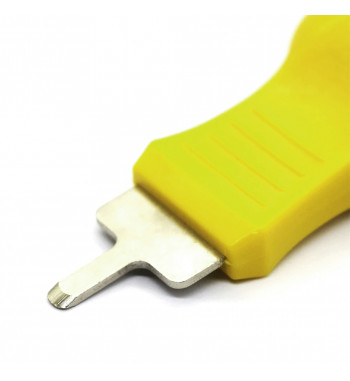
The fine-tip opener uses an extra-narrow polished steel blade — about 0.4 mm thick — that slides into the tiniest case-back lip. Combined with an ergonomic handle, it gives the watchmaker the control needed to open a 5 mm thin case without scratching the lugs or compressing the crystal gasket.
Reach for the fine-tip opener when working on dress watches, ladies' cocktail watches, vintage Omega De Ville or Seiko Presage. It is also the right choice for cases where a previous service has left a tight lip.
Examine the case under a loupe to locate the slot. On some models the slot is hidden between two lugs.
Watch gaskets exist in several elastomer families, each with its own properties. NBR (nitrile butadiene rubber) is the most common and offers good resistance to oils and ageing. FKM (also marketed as Viton) withstands higher temperatures and aggressive solvents, and is the preferred choice for professional dive watches. EPDM resists ozone and weathering and is often found on sport models. Hytrel, a thermoplastic elastomer, is used on certain Rolex and Omega references. This tool is fully compatible with all four families, provided the gasket is lubricated with a silicone grease such as Moebius 8217.
It can be safely used on Swiss makes (Rolex Submariner, Omega Seamaster, Tissot PRX, Longines HydroConquest), Japanese makes (Seiko 5, Seiko Prospex, Citizen Promaster) and German makes (Sinn, Junghans) as long as the case-back type matches the tool's purpose. For watches rated above 10 ATM, always pressure-test after every gasket service.
Keep the tool dry, in a clean drawer or its original sleeve. Wipe the metallic parts with a soft cloth after each use; if you have worked near solvents, dry the steel parts immediately to prevent corrosion. Inspect the working surface (tip, head or die) for marks or burrs every few months; small irregularities can be polished gently with a fine-grit abrasive cloth, but heavier damage requires replacement.
Avoid contact with strong acids, chlorinated cleaners and rubbing alcohol on plastic handles. Heat above 60 °C can soften polymer grips and reduce dimensional accuracy on precision blades — never leave the tool in direct sunlight or near a soldering iron.
Three errors account for the majority of damage observed in workshops: applying excessive torque (which strips the case-back notches), using the wrong tip diameter (which slips and scratches the bezel), and forgetting to replace a hardened gasket after service (which compromises water resistance even with a fresh O-ring of the wrong size). Always work under a loupe, double-check the gasket reference before ordering a replacement, and verify the seating of the case-back before closing the watch.
A final tip from the workshop: never combine a new gasket with an old, dried-out one on a multi-seal case. If the case-back gasket is replaced, also inspect the crown gasket and the crystal gasket — they age at the same rate and a single tired O-ring will let humidity in.
The fine-tip opener is machined from a single piece of hardened steel and polished to avoid micro-burrs. It is supplied in a protective sleeve.
It will work, but a standard 1 mm tip provides more leverage on robust snap-back divers.
On this model the tip is integral; a separate interchangeable-tip opener is available in our catalogue.
Avoid contact with hard metals; store it in its sleeve to preserve the polished edge.
Fine-tip watch opening tool. Designed for watchmakers and home repair of mechanical, automatic and quartz watches.