
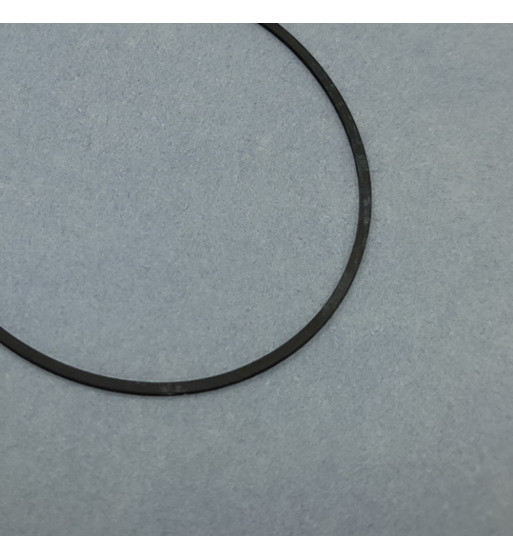
Flat watchmaker repair gasket sheet 1.00 mm. Reliable seal against water, dust and humidity.
This flat gasket of 1,00 mm is a generous-section sealing component intended for vintage and modern watches whose case-back requires a wide, flat profile rather than a round O-ring. Cut from NBR rubber (acrylonitrile-butadiene) sheet, it provides a uniform pressure footprint between the case middle and the case-back, which is exactly what older pocket watches, dress watches with snap-on backs and certain divers from the 1960s and 1970s expect.
The flat gasket of 1,00 mm is the traditional answer to sealing a snap-on or screw-down case-back that runs on a flat shoulder rather than a machined O-ring groove. Cut from calibrated sheet, its parallel faces compress evenly under the closing force, so the leak path along the case middle is shut down across the entire perimeter at once. This profile is the only one that suits many older Swiss, German and Japanese movements whose case shoulders were never engineered for a round O-ring.
It is also commonly used as a crystal gasket under pressed mineral or acrylic crystals, and occasionally as a static seal under bezel inserts. Made of NBR rubber (acrylonitrile-butadiene) formulated for watchmaking, it combines stable elasticity over years of compression with chemical compatibility with light watch oils, alcohol-based cleaning solvents and the Moebius 8217 silicone grease that the watchmaker applies during reassembly.
The flat gasket of 1,00 mm is the part you reach for when a pocket watch or a snap-on case-back no longer holds its grip, when the inside of the case shows the typical brown halo left by water, or when the previous repair clearly used a generic O-ring that does not actually match the original profile. It is also the right choice when a pressed mineral or acrylic crystal is being refitted and the case rim does not feature a proper O-ring groove.
For modern divers from Rolex, Omega and Seiko, the flat profile shows up under the bezel insert and occasionally under the screw-down case-back on certain references; in those cases this thickness is the one that restores factory compression. Whenever you open such a watch, replace the flat gasket, lubricate the seat with Moebius 8217 silicone grease and check water resistance to the original 3, 5 or 10 ATM rating.
Each batch of gaskets is checked dimensionally with a profile projector and randomly tested for hardness on a Shore A durometer before shipment. The NBR rubber (acrylonitrile-butadiene) compound is sourced from a European supplier with full RoHS and REACH compliance, and the gaskets are stored away from ozone and direct sunlight to preserve elasticity. For watchmakers who service vintage chronographs or warm chronometers, an alternative FKM / Viton fluoroelastomer variant and an EPDM variant are available on request, both compatible with Moebius 8217 silicone grease.
Only if the case shoulder is itself flat and the previous gasket was already a flat one. A flat seal cannot recreate the lip effect of a round O-ring in a V-groove; in that case order the correct 1,00 mm O-ring instead.
Measure the case shoulder where the flat gasket sits with a caliper; the inside diameter of the new gasket must be 0.1 to 0.2 mm smaller so it sits without play. The outside diameter must clear the inner wall of the case-back.
Most snap-back pocket watches use a flat profile in the 1,00 mm range — measure first; the cord thickness is the critical dimension and the inside diameter must match the rebate cut in the case middle.
Flat watchmaker repair gasket sheet 1.00 mm. Reliable seal against water, dust and humidity.