
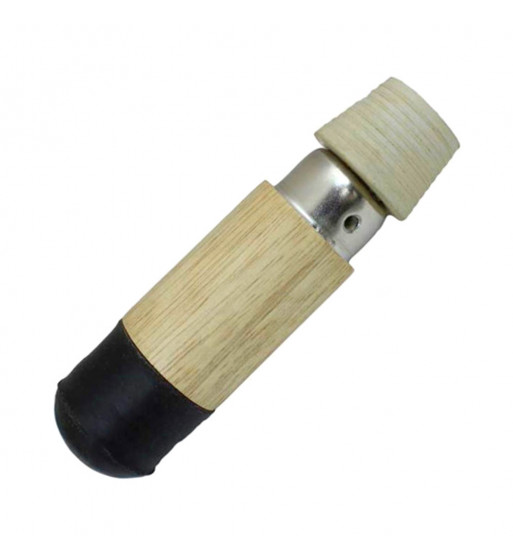
Tool for opening waterproof screw-down watches. Designed for watchmakers and home repair of mechanical, automatic and quartz watches.
This professional watch case opener is the tool that every workbench needs the first time a screw-down case-back refuses to budge. Machined from hardened tool steel with a knurled grip, it engages the notches of a screw-back firmly and squarely, transmitting torque through three or six adjustable pins that lock into the case-back slots used on Rolex, Omega, Seiko and most modern divers.
This screw-back opener is built around a heavy steel body that absorbs the force needed to free a stiff case-back without slipping. Two or three adjustable arms slide along a precision rail and lock onto the case-back with hex-head pins, while a knurled body gives the watchmaker enough leverage to break the seal of a Rolex Oyster, Omega Seamaster or Seiko Diver without marking the lugs. The tool ships ready for everyday workshop use on cases between roughly 18 and 62 mm in diameter.
The pin set covers the four most common case-back slot geometries — round, square, hexagonal and rectangular — so the same body handles screw-down covers from Swiss, Japanese, German and Chinese manufactures. The opener is the natural companion to the gasket assortment offered on this site: every time the back comes off, the watchmaker should inspect the case-back gasket and replace it if it has lost section, taken a compression set or hardened.
The opener comes out of the drawer whenever a screw-down case-back has to be removed for a battery change, a movement service, a gasket replacement or a leak diagnosis. In a properly equipped workshop it is paired with a watch case holder so the body is locked in place while the operator applies torque to the handle. Used correctly, it leaves no mark on the case-back; used carelessly, the pins will skate and score the steel, so practice on a scrap case before tackling a Rolex Oyster or an Omega Seamaster.
The opener is also a diagnostic instrument: a back that takes too much torque to break free usually tells the watchmaker that the case-back gasket has bonded to the case middle through a hardened O-ring, and that the entire gasket set should be replaced together with a fresh coat of Moebius 8217 silicone grease.
Each batch of tools is checked dimensionally with a profile projector and randomly tested for hardness on a Shore A durometer before shipment. The NBR rubber (acrylonitrile-butadiene) compound is sourced from a European supplier with full RoHS and REACH compliance, and the gaskets are stored away from ozone and direct sunlight to preserve elasticity. For watchmakers who service vintage chronographs or warm chronometers, an alternative FKM / Viton fluoroelastomer variant and an EPDM variant are available on request, both compatible with Moebius 8217 silicone grease.
Yes — the four pin geometries cover the slots used on Rolex Oyster, Datejust and Submariner cases, as well as on Omega Seamaster and Seiko Diver. For maximum security on collector pieces, fit the case in a soft-jaw holder and use new pins.
Brand specifications typically range from 2 to 4 Nm for a 40 mm dive watch case-back. Tighten by hand first, then bring up to the specified torque with the same tool; over-torque damages the case-back gasket and the thread.
Stock a calibrated assortment of O-ring gaskets from 0,30 to 1,00 mm in NBR rubber (acrylonitrile-butadiene), plus a tube of Moebius 8217 silicone grease. Replace the case-back gasket every time the back is removed; this is the single best habit for maintaining factory water resistance.
Tool for opening waterproof screw-down watches. Designed for watchmakers and home repair of mechanical, automatic and quartz watches.